TECHNOLOGY & COMPUTING
Artificial Intelligence Specialist
Building Systems That Learn and Assist
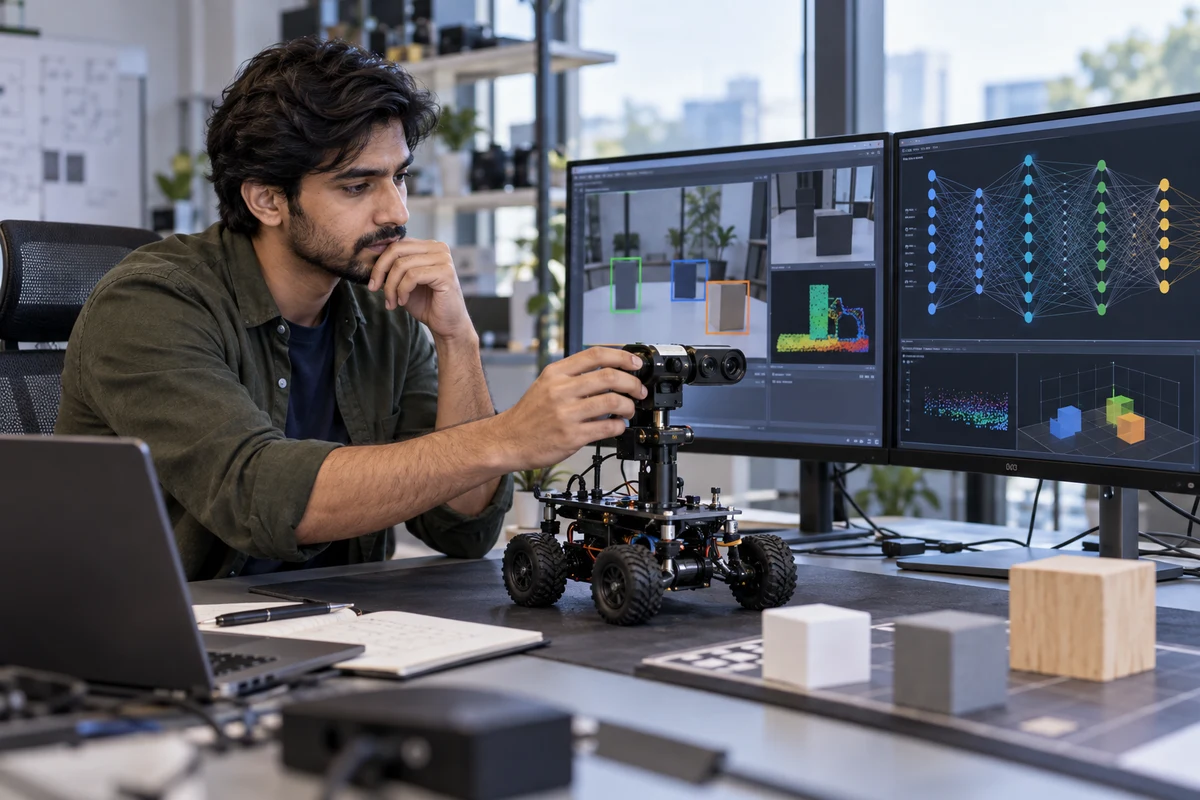
AI specialists design, train, evaluate and deploy systems that perform tasks involving prediction, language, vision, planning or decision support. Responsible AI work also examines safety, bias and human impact.
Key Outcomes
What this career leads to
- Intelligent automation
- Better predictions
- Human-centred tools
- Responsible deployment
What They Do
On the job
- Prepare data and select suitable modelling approaches
- Train and evaluate machine-learning systems
- Integrate models into reliable applications
- Monitor performance, bias, safety and changing data
Where They Work
Typical workplaces
- Technology companies
- Research laboratories
- Healthcare and financial organisations
- Manufacturing and robotics firms
- Universities
- Government and consulting teams
Core Skills
What it takes
- Machine learning and mathematics
- Programming and software engineering
- Experimentation and model evaluation
- Responsible-AI judgement and communication
Areas of Application
Where this knowledge shows up
- Natural-language processing
- Computer vision
- Predictive systems
- Robotics and intelligent control
- AI safety, evaluation and governance
Education & Entry Path
The learning route
Common foundations include computer science, artificial intelligence, data science, mathematics or engineering. Strong programming and project experience are essential; advanced research roles frequently require postgraduate study.
Career Scope
The long view
AI specialists may work as machine-learning engineers, applied scientists, AI researchers, evaluators, product specialists or governance professionals. Roles change quickly, so continuous learning is central.
Related Careers
Kindred paths to explore
Explore Scientists’ Contribution
The discoveries behind this field
- Alan Turing 1912 - 1954 Mathematics Conceptualised the Turing machine and artificial intelligence Read their profile
- Al-Jazari c. 1136 - 1206 Technology Ingenious automata and mechanical devices Read their profile
- Nikola Tesla 1856 - 1943 Physics Invented alternating current (AC) power system Read their profile
- Al-Zahrawi c. 936 - 1013 Medicine Father of modern surgery; authored Al-Tasrif Read their profile