
SCIENCE & RESEARCH
Astronomer / Astrophysicist
Studying the Universe Beyond Earth
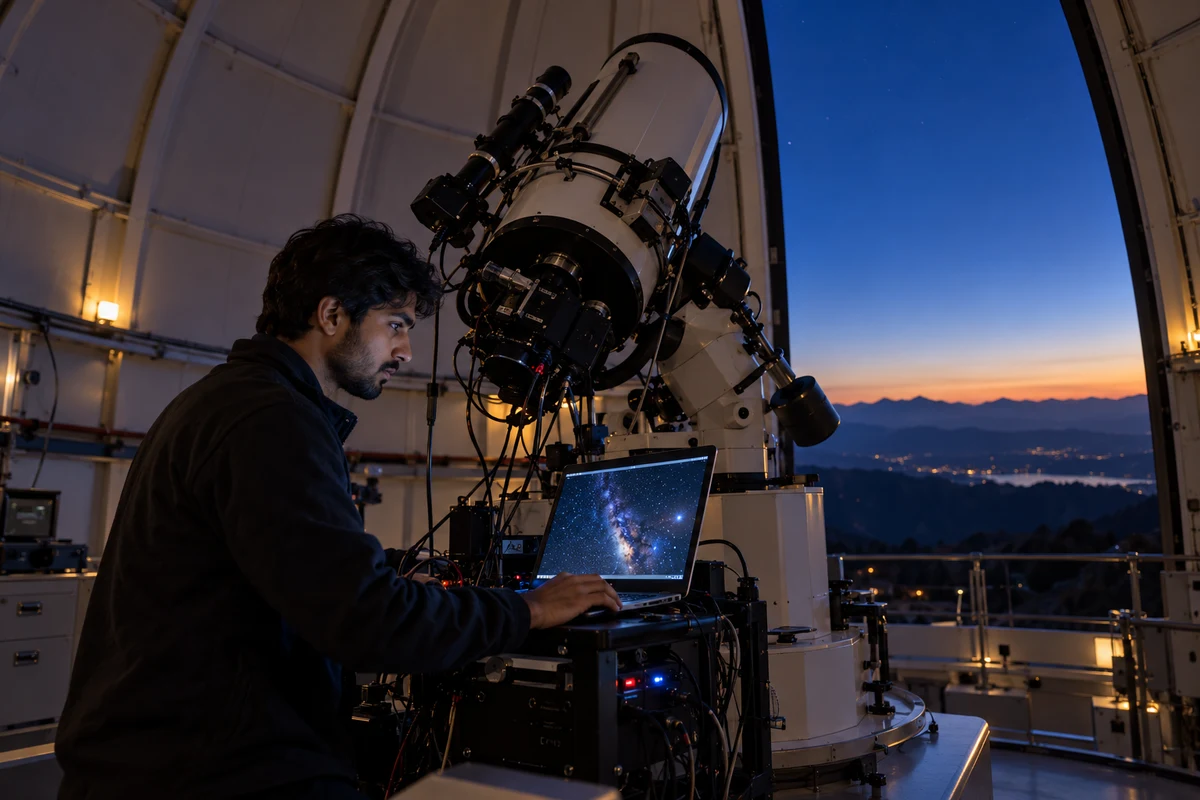
Astronomers and astrophysicists investigate stars, planets, galaxies, radiation and the evolution of the universe. Much of their work combines physics, mathematics, observation and computing.
Key Outcomes
What this career leads to
- Cosmic understanding
- Precise observation
- Advanced data analysis
- Scientific discovery
What They Do
On the job
- Plan observations or computational studies
- Process data from telescopes, satellites or simulations
- Develop and test models of astronomical phenomena
- Publish findings and collaborate with international research teams
Where They Work
Typical workplaces
- Universities and observatories
- Space and research agencies
- Planetariums and science centres
- Data and software organisations
- Engineering laboratories
- International research collaborations
Core Skills
What it takes
- Physics and advanced mathematics
- Programming and large-scale data analysis
- Research design
- Scientific writing and collaboration
Areas of Application
Where this knowledge shows up
- Planetary science
- Stellar and galactic astronomy
- Cosmology
- High-energy astrophysics
- Astronomical instrumentation
Education & Entry Path
The learning route
A strong degree in physics, astronomy or a related subject is the usual foundation. Professional research and academic positions commonly require a master's degree or doctorate.
Career Scope
The long view
Careers include research, observatory operations, instrumentation, scientific software, data analysis, education and science communication. Permanent research positions are competitive and usually require advanced training.
Related Careers
Kindred paths to explore
Explore Scientists’ Contribution
The discoveries behind this field
- Galileo Galilei 1564 - 1642 Physics Father of modern observational astronomy and kinematics Read their profile
- Stephen Hawking 1942 - 2018 Physics Hawking radiation and singularity theorems Read their profile
- Al-Biruni c. 973 - 1048 Astronomy Measured the Earth; wrote encyclopaedically across the sciences Read their profile
- Isaac Newton 1643 - 1727 Physics Laws of Motion and Universal Gravitation Read their profile