
SCIENCE & RESEARCH
Biotechnologist
Using Living Systems to Solve Real Problems
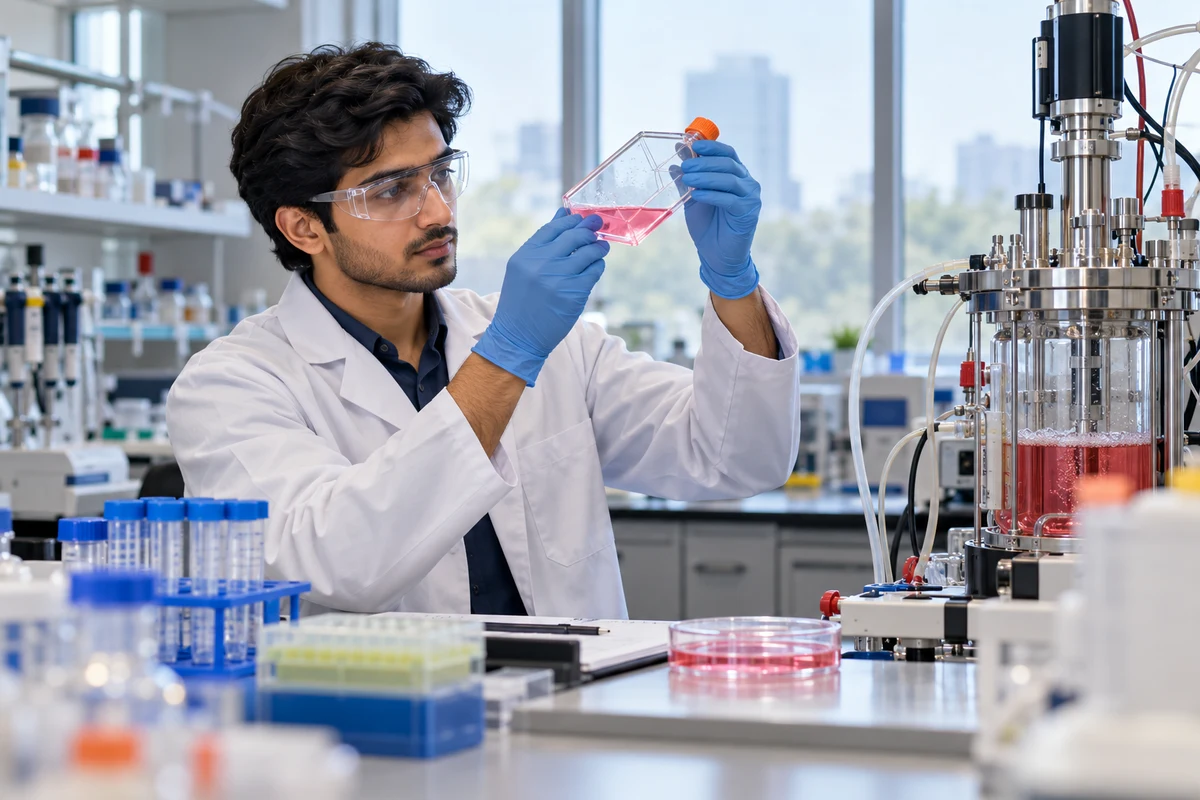
Biotechnologists use cells, organisms and biological processes to develop useful products and methods in medicine, agriculture, food, industry and the environment.
Key Outcomes
What this career leads to
- New biological solutions
- Improved products
- More efficient processes
- Evidence-based innovation
What They Do
On the job
- Design and perform biological experiments
- Culture cells or microorganisms under controlled conditions
- Analyse biological data and document results
- Help develop or improve products and production processes
Where They Work
Typical workplaces
- Biotechnology companies
- Pharmaceutical laboratories
- Agricultural and food organisations
- Universities and research institutes
- Diagnostic laboratories
- Environmental and industrial facilities
Core Skills
What it takes
- Molecular and cellular biology
- Laboratory technique and biosafety
- Data analysis and scientific writing
- Experimental design and teamwork
Areas of Application
Where this knowledge shows up
- Medical biotechnology
- Agricultural biotechnology
- Industrial bioprocessing
- Food biotechnology
- Environmental biotechnology
Education & Entry Path
The learning route
A bachelor's degree in biotechnology, biological sciences or a related field is a common entry route. Research-intensive and advanced development roles often require postgraduate study.
Career Scope
The long view
Biotechnologists may work in laboratory research, production, quality control, regulatory support, diagnostics, bioinformatics or product development. Available roles depend strongly on local industry and research investment.
Related Careers
Kindred paths to explore
Explore Scientists’ Contribution
The discoveries behind this field
- Gregor Mendel 1822 - 1884 Biology Laws of Inheritance; father of modern genetics Read their profile
- Louis Pasteur 1822 - 1895 Medicine Germ theory of disease and pasteurisation Read their profile
- Alexander Fleming 1881 - 1955 Medicine Discovered penicillin, revolutionising medicine Read their profile
- Galileo Galilei 1564 - 1642 Physics Father of modern observational astronomy and kinematics Read their profile