
SCIENCE & RESEARCH
Physicist
Explaining the Laws That Shape the Universe
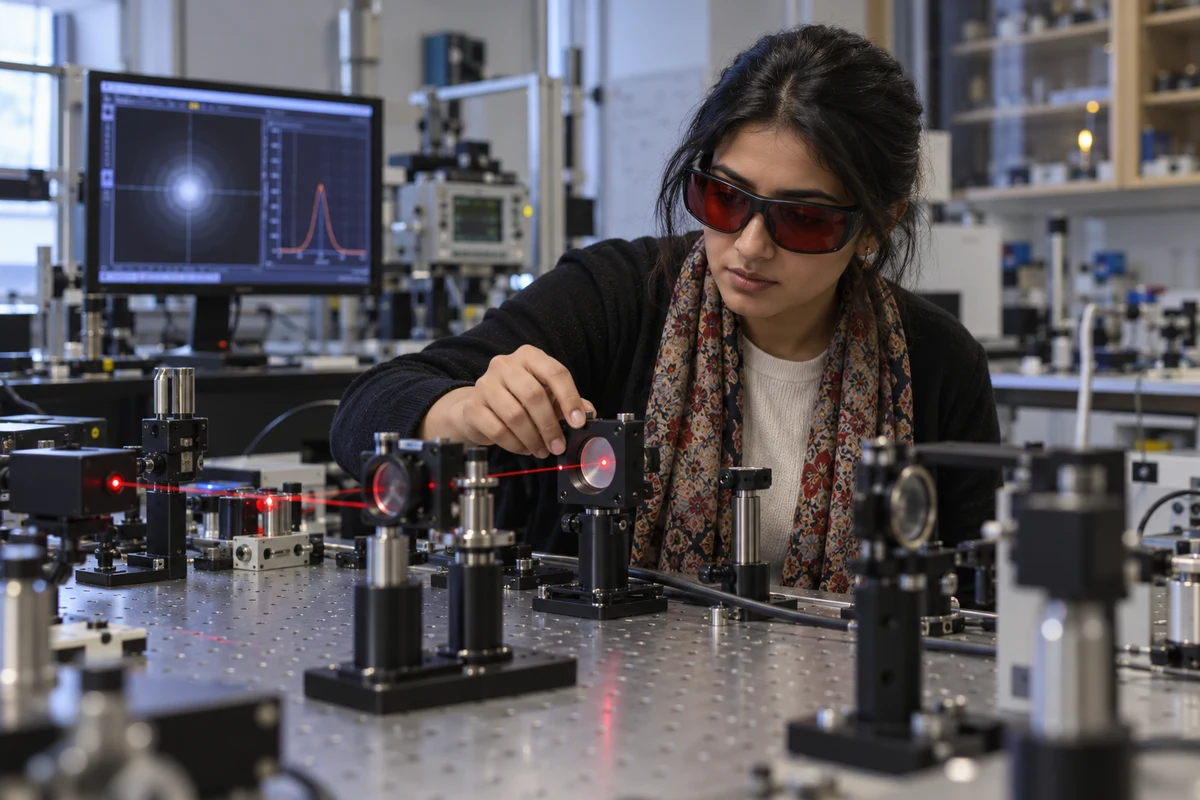
Physicists investigate matter, energy, motion, forces and the fundamental rules of nature. They build mathematical models, perform experiments and apply physical principles to real systems.
Key Outcomes
What this career leads to
- Deeper natural understanding
- Predictive models
- Advanced measurement
- Technology foundations
What They Do
On the job
- Develop theories or experimental questions
- Build models and analyse quantitative data
- Design, conduct or simulate experiments
- Communicate results through reports, papers and presentations
Where They Work
Typical workplaces
- Universities and research institutes
- Energy and technology organisations
- Hospitals and medical-physics departments
- Government laboratories
- Engineering and manufacturing companies
- Data and computational teams
Core Skills
What it takes
- Mathematics and logical reasoning
- Experimental or computational methods
- Data analysis
- Curiosity, precision and scientific communication
Areas of Application
Where this knowledge shows up
- Theoretical physics
- Applied and engineering physics
- Medical physics
- Materials and condensed-matter physics
- Nuclear, particle and energy physics
Education & Entry Path
The learning route
A bachelor's degree in physics supports technical and analytical roles. Research scientist, university and specialised medical-physics careers generally require postgraduate or professional training.
Career Scope
The long view
Physics graduates enter research, education, energy, medical technology, instrumentation, modelling, computing and data-intensive work. The career path depends on specialisation and level of study.
Related Careers
Kindred paths to explore
Explore Scientists’ Contribution
The discoveries behind this field
- Max Planck 1858 - 1947 Physics Quantum theory — energy carried in discrete packets Read their profile
- Galileo Galilei 1564 - 1642 Physics Father of modern observational astronomy and kinematics Read their profile
- Stephen Hawking 1942 - 2018 Physics Hawking radiation and singularity theorems Read their profile
- Marie Curie 1867 - 1934 Chemistry Pioneered research on radioactivity; first woman Nobel laureate Read their profile