
Then
His wartime code-breaking helped shorten the war, and his 1936 paper supplied the theoretical basis for the stored-program computer.
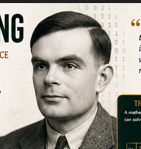
Timeline of Discovery · 28 / 30
1912 - 1954 · England
Alan Turing imagined the “universal machine” — a single device that could compute anything computable — and helped build the earliest computers and code-breaking machinery.
What, exactly, can be calculated, and can one machine carry out any calculation?
What this scientist actually did — precisely and plainly.
He defined the theoretical Turing machine, proposed tests for machine intelligence, and played a decisive wartime role breaking the Enigma cipher.
The tools, experiments and reasoning behind the discovery.
He moved abstract mathematics and logic into engineering reality, designing and programming the Bombe and later the ACE computer.
From their own moment in history to the world we live in now.
His wartime code-breaking helped shorten the war, and his 1936 paper supplied the theoretical basis for the stored-program computer.
Every modern computer is a Turing machine in principle; his Turing test still frames AI discussions, and his life shaped the fight for fair treatment of LGBTQ+ people.
Landmarks that carried the idea into the world.
We can only see a short distance ahead, but we can see plenty there that needs to be done.
Where this profile was verified.
Last reviewed: 2026-09-22
Follow their field into the Career Atlas