
Then
His publication was initially overlooked, but Florey and Chain’s team later extracted working penicillin, saving enormous numbers of lives in World War II.
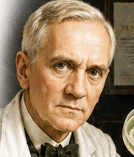
Timeline of Discovery · 26 / 30
1881 - 1955 · Scotland
Alexander Fleming noticed that a stray mould killed bacteria — a single observation that led, through later work, to the first antibiotic, penicillin.
What killed the bacteria in my dish, and can a natural substance fight bacterial infection?
What this scientist actually did — precisely and plainly.
He observed that a mould (Penicillium) destroyed surrounding bacteria, named the substance penicillin, and his discovery was later purified and mass-produced as the antibiotic era’s first drug.
The tools, experiments and reasoning behind the discovery.
He was a meticulous observer who noticed an anomaly others might discard, then tested the mould’s effect on stubborn bacteria.
From their own moment in history to the world we live in now.
His publication was initially overlooked, but Florey and Chain’s team later extracted working penicillin, saving enormous numbers of lives in World War II.
Antibiotics remain a cornerstone of medicine — and their overuse is why antimicrobial resistance is now one of the world’s great health challenges.
Landmarks that carried the idea into the world.
One sometimes finds what one is not looking for.
Where this profile was verified.
Last reviewed: 2026-09-22
Follow their field into the Career Atlas