
Then
His “Elements of Chemistry” and the oxygen theory ended the phlogiston era and gave chemistry a clear language and conservation law.
Timeline of Discovery · 15 / 30
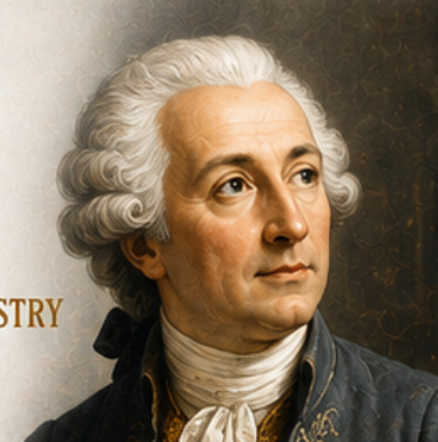
1743 - 1794 · France
Antoine Lavoisier reframed chemistry around careful measurement and named oxygen, sweeping away the old “phlogiston” theory of burning.
What actually happens to matter when things burn, rust or react?
What this scientist actually did — precisely and plainly.
He showed that combustion and respiration involve a gas, later named oxygen, and that mass is conserved in chemical reactions — turning chemistry into a quantitative science.
The tools, experiments and reasoning behind the discovery.
He used balances to weigh reactants and products precisely, designed closed-system experiments, and applied naming rules that chemists still follow.
From their own moment in history to the world we live in now.
His “Elements of Chemistry” and the oxygen theory ended the phlogiston era and gave chemistry a clear language and conservation law.
Stoichiometry, chemical equations and the conservation of mass are fundamental; modern chemistry and energy science descend directly from his balance.
Landmarks that carried the idea into the world.
Nothing is lost, nothing is created, everything is transformed.
Where this profile was verified.
Last reviewed: 2026-09-22
Follow their field into the Career Atlas