
Then
His “What is Life?” essay inspired the founding of molecular biology, and his equation gave quantum mechanics a calculable core.
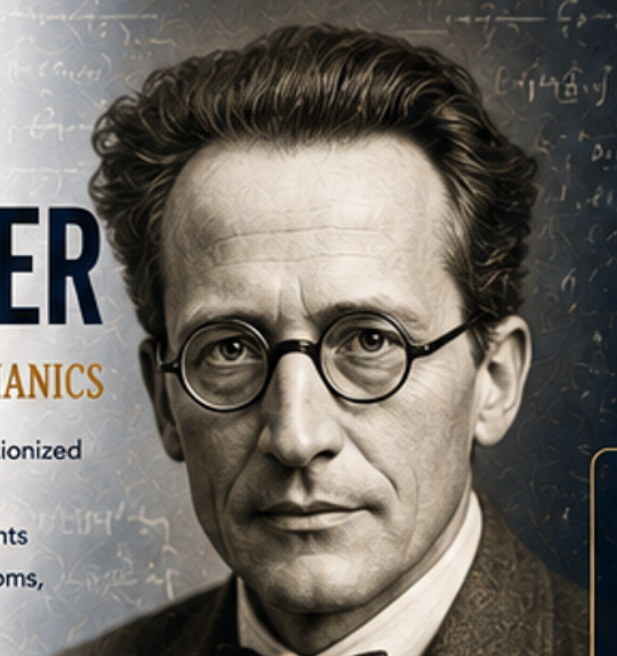
Timeline of Discovery · 27 / 30
1887 - 1961 · Austria / Ireland
Erwin Schrödinger wrote the wave equation that governs how quantum systems behave, placing the new atomic physics on a firm mathematical footing.
How can a theory describe things that behave as both particles and waves at the scale of electrons?
What this scientist actually did — precisely and plainly.
His equation describes how a quantum “wave function” evolves, successfully modelling atoms and molecules and winning a Nobel Prize shared with Dirac.
The tools, experiments and reasoning behind the discovery.
He combined the wave ideas of de Broglie with classical mechanics mathematics, drew both on intuition and consistency, and wrote the equation that worked.
From their own moment in history to the world we live in now.
His “What is Life?” essay inspired the founding of molecular biology, and his equation gave quantum mechanics a calculable core.
The Schrödinger equation underlies chemistry, semiconductor design and quantum computing research — nearly all modern technology operates through its mathematics.
Landmarks that carried the idea into the world.
Where this profile was verified.
Last reviewed: 2026-09-22
Follow their field into the Career Atlas