
Then
His telescopic evidence undercut the Earth-centred cosmos and he championed heliocentrism despite opposition from the Church, for which he was tried.
Timeline of Discovery · 12 / 30
1564 - 1642 · Italy
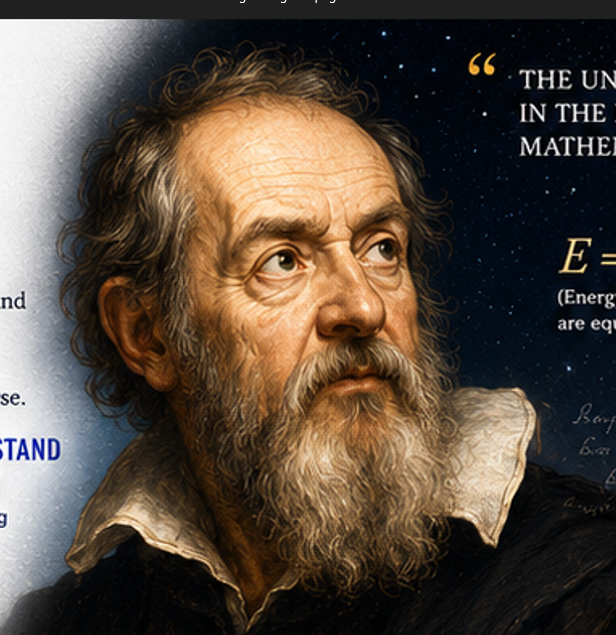
Galileo Galilei turned the newly invented telescope to the heavens and built modern experimental physics on the careful study of motion.
What do careful observation and measurement tell us about falling bodies, pendulums and the sky?
What this scientist actually did — precisely and plainly.
He observed the moons of Jupiter, the phases of Venus and the rugged Moon, and he established that falling bodies accelerate uniformly regardless of their mass.
The tools, experiments and reasoning behind the discovery.
He combined instrument observation, controlled experiments (such as balls on inclines), mathematics and relentless measurement.
From their own moment in history to the world we live in now.
His telescopic evidence undercut the Earth-centred cosmos and he championed heliocentrism despite opposition from the Church, for which he was tried.
Experimentation, instrumentation and quantitative reasoning are the engines of physics; his case also stands as the classic lesson on science versus authority.
Landmarks that carried the idea into the world.
Measure what is measurable, and make measurable what is not so.
Where this profile was verified.
Last reviewed: 2026-09-22
Follow their field into the Career Atlas