
Then
His optics corrected the old idea that the eye emits rays, and his books carried experimental thinking across the Islamic world to Europe.
Timeline of Discovery · 5 / 30
c. 965 - 1040 · Islamic Golden Age (Basra / Cairo)
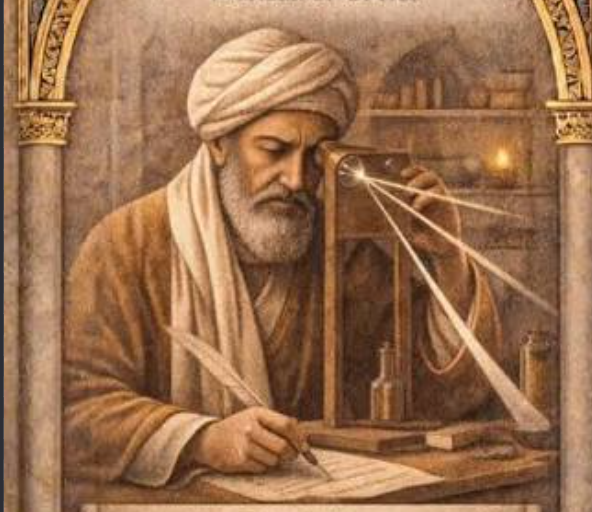
Ibn al-Haytham, known as Alhazen in Europe, transformed the study of light and sight and is often called one of the earliest scientists to rely on controlled experimentation.
How does light travel, and how do we actually see objects?
What this scientist actually did — precisely and plainly.
In his “Book of Optics” he argued that vision happens when light reflected from objects enters the eye, and he described pinhole imaging and the camera obscura.
The tools, experiments and reasoning behind the discovery.
He combined geometry with repeatable experiments — controlling light sources, apertures and screens — to test his claims, a method far ahead of his time.
From their own moment in history to the world we live in now.
His optics corrected the old idea that the eye emits rays, and his books carried experimental thinking across the Islamic world to Europe.
The camera obscura led to photography and cameras; his approach of hypothesis plus experiment became the backbone of the modern scientific method.
Landmarks that carried the idea into the world.
Where this profile was verified.
Last reviewed: 2026-09-22
Follow their field into the Career Atlas