
Then
His work made physics quantitative and unified for the first time, shaping science and engineering for two centuries.
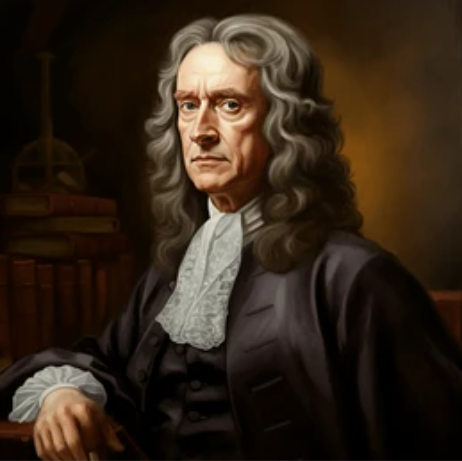
Timeline of Discovery · 14 / 30
1643 - 1727 · England
Isaac Newton united motion and gravity in the “Principia”, laying the mathematical foundations for physics and offering one law that explained both apples and planets.
Can one set of laws explain how objects move on Earth and how planets move in the sky?
What this scientist actually did — precisely and plainly.
He set out the laws of motion and universal gravitation, explaining Kepler’s planetary rules, the Moon’s motion, tides and falling bodies within a single mathematical system.
The tools, experiments and reasoning behind the discovery.
He built the calculus, performed careful experiments on light and motion, and framed mechanics with force-and-acceleration laws that could predict outcomes.
From their own moment in history to the world we live in now.
His work made physics quantitative and unified for the first time, shaping science and engineering for two centuries.
His mechanics still governs most engineering, orbital mechanics, bridges, vehicles and biomechanics; relativity and quantum theory refine rather than replace it.
Landmarks that carried the idea into the world.
If I have seen further, it is by standing on the shoulders of giants.
Where this profile was verified.
Last reviewed: 2026-09-22
Follow their field into the Career Atlas