
Then
He replaced circular-geometry guesswork with laws expressed in numbers, changing astronomy from description into mathematical law.
Timeline of Discovery · 13 / 30
1571 - 1630 · Holy Roman Empire (Germany)
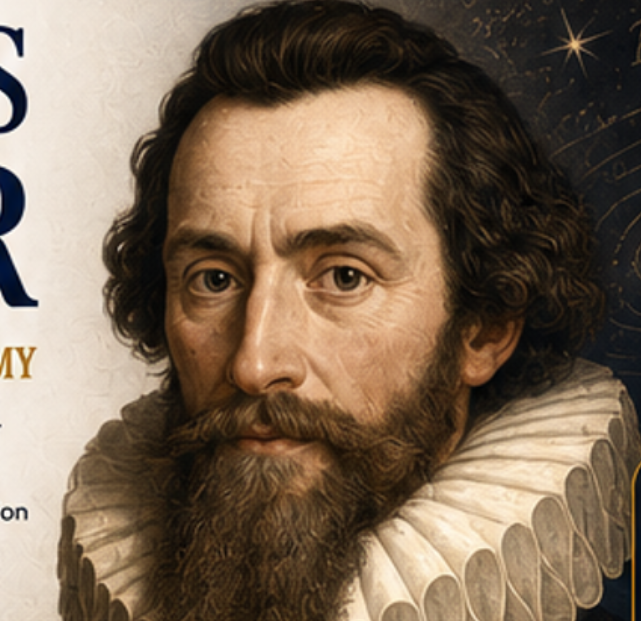
Johannes Kepler discovered that planets travel in ellipses and obey three simple laws, unifying the Sun-centred astronomy into a coherent physical system.
Is there a simple, consistent rule behind every planet’s motion around the Sun?
What this scientist actually did — precisely and plainly.
His three laws describe elliptical orbits, orbital speeds varying by distance, and a precise link between a planet’s distance and its period.
The tools, experiments and reasoning behind the discovery.
He worked from Tycho Brahe’s superb observations, testing and discarding models one by one until ellipses and the three laws fitted the data.
From their own moment in history to the world we live in now.
He replaced circular-geometry guesswork with laws expressed in numbers, changing astronomy from description into mathematical law.
Kepler’s laws still describe satellites, exoplanets and spacecraft trajectories, and his insistence on matching numbers to data defines computational science.
Landmarks that carried the idea into the world.
Where this profile was verified.
Last reviewed: 2026-09-22
Follow their field into the Career Atlas