
Then
Her discoveries opened atomic physics and gave medicine a new tool — radiation — and her two Nobel Prizes (Physics 1903, Chemistry 1911) broke ground for women in science.
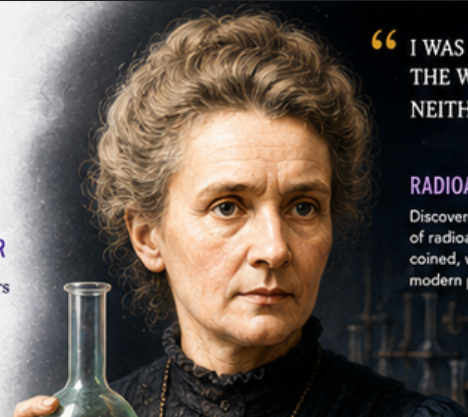
Timeline of Discovery · 24 / 30
1867 - 1934 · Poland / France
Marie Curie isolated radium and polonium and founded the science of radioactivity, the only person to win Nobel Prizes in two sciences.
What is the mysterious “radiation” that uranium gives off, and can new elements be separated from ores?
What this scientist actually did — precisely and plainly.
With her husband Pierre, she purified two new elements and showed that radioactivity is an atomic property, naming the phenomenon itself.
The tools, experiments and reasoning behind the discovery.
She developed painstaking chemical separation and precise measurement, processing tonnes of ore by hand to isolate trace amounts of new elements.
From their own moment in history to the world we live in now.
Her discoveries opened atomic physics and gave medicine a new tool — radiation — and her two Nobel Prizes (Physics 1903, Chemistry 1911) broke ground for women in science.
Radioactive tracers and radiotherapy save lives in medicine, and her measurement techniques became the backbone of nuclear science.
Landmarks that carried the idea into the world.
Nothing in life is to be feared, it is only to be understood.
Where this profile was verified.
Last reviewed: 2026-09-22
Follow their field into the Career Atlas