
Then
Planck’s law was the first exact description of black-body radiation and earned him the 1918 Nobel Prize. Einstein, Bohr and others quickly built on it to explain atoms, light and matter.
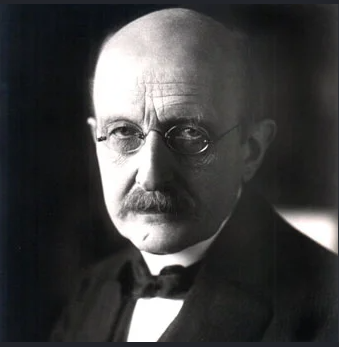
Timeline of Discovery · 23 / 30
1858 - 1947 · Germany
Max Planck, a German theoretical physicist, proposed in 1900 that energy is emitted and absorbed in discrete packets, or quanta — the idea that quietly began the quantum revolution in physics.
Why does a hot, glowing object give off light with a very specific colour at every temperature, and how can that spectrum be predicted?
What this scientist actually did — precisely and plainly.
To solve the black-body radiation puzzle, Planck found he had to treat energy as coming in tiny, indivisible packets — quanta — whose size is fixed by a constant, h, now called Planck’s constant. His law predicted the observed spectrum perfectly.
The tools, experiments and reasoning behind the discovery.
He combined thermodynamics with a bold mathematical assumption: energy could only be exchanged in whole-number multiples of h × frequency. The constant he introduced sits at the heart of quantum theory.
From their own moment in history to the world we live in now.
Planck’s law was the first exact description of black-body radiation and earned him the 1918 Nobel Prize. Einstein, Bohr and others quickly built on it to explain atoms, light and matter.
Planck’s constant is fundamental to modern physics. The quantum theory his idea launched underpins semiconductors, lasers, LEDs, medical imaging and emerging quantum computers.
Landmarks that carried the idea into the world.
Science cannot solve the ultimate mystery of nature. And that is because, in the last analysis, we ourselves are part of nature and therefore part of the mystery that we seek to solve.
Where this profile was verified.
Last reviewed: 2026-09-22
Follow their field into the Career Atlas