
Then
His model replaced geocentric astronomy for later astronomers, even though it still used circular orbits and needed epicycles, and it triggered fierce debate.
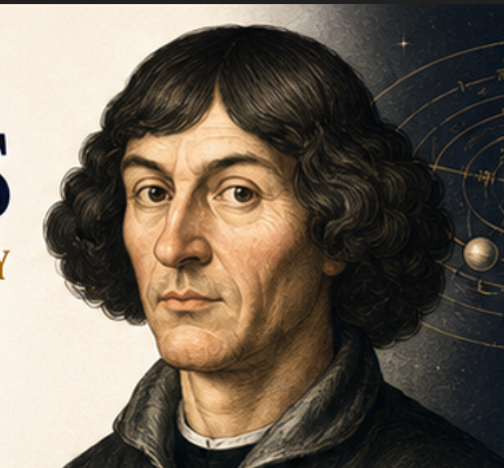
Timeline of Discovery · 11 / 30
1473 - 1543 · Poland
Nicolaus Copernicus proposed that the Sun, not the Earth, sits near the centre of the known universe — the idea that ignited the scientific revolution in astronomy.
Could the confusing movements of planets become simple and orderly if we assume the Earth moves around the Sun?
What this scientist actually did — precisely and plainly.
In “On the Revolutions of the Heavenly Spheres” he placed the Sun at rest near the centre, with the Earth and planets orbiting it, and gave the first detailed heliocentric model.
The tools, experiments and reasoning behind the discovery.
He analysed centuries of observations, simplified geometry where the Earth-centred model was tangled, and published his model with mathematical tables.
From their own moment in history to the world we live in now.
His model replaced geocentric astronomy for later astronomers, even though it still used circular orbits and needed epicycles, and it triggered fierce debate.
Heliocentrism is the foundation of all modern planetary astronomy, calendar science and how we locate ourselves in the cosmos.
Landmarks that carried the idea into the world.
At rest, however, in the middle of everything is the sun.
Where this profile was verified.
Last reviewed: 2026-09-22
Follow their field into the Career Atlas